A space can be beautifully decorated and still feel unsettling. Often, the difference lies not in what you see, but in what you smell. Adjusting the scent intensity is therefore no minor detail: it determines whether a scent blends elegantly into your interior or unintentionally demands all the attention. The right setting gives a home, workplace, or store a distinctive signature—subtle, refined, and just present enough.
A premium diffuser makes that process controllable. Not by filling a space with a brief, heavy cloud of scent, but by diffusing the scent evenly and continuously. This way, the atmosphere remains intact, from your first cup of coffee in the morning until the moment you close the door behind you.
Setting the scent intensity starts with the space.
The best setting is rarely simply the highest setting. Square meters, ceiling height, ventilation, and the use of the space all combine to determine how much scent feels pleasant. A compact bedroom calls for a different intensity than an open living space with high ceilings. In a boutique, salon, or reception area, the scent must also be noticeable without overpowering the conversation, the product, or the customer experience.
Therefore, first consider the actual space, not just the number of rooms. An open-concept kitchen and living room often form a single scent zone. Conversely, a hallway with doors leading to multiple rooms quickly loses scent to adjacent spaces. Similarly, a space with a lot of textiles—curtains, rugs, and upholstered furniture—retains scent longer than a minimalist interior featuring stone, glass, and metal.
Choose a diffuser that matches the coverage you need. A model that’s too small running at maximum power is less effective than a model with sufficient capacity set to a lower setting. Conversely, a powerful diffuser in a small space isn’t a bad choice, as long as you carefully adjust the output. Control is the luxury.
Smaller spaces: keep the scent close by.
In a bathroom, bedroom, home office, or entryway, a low-to-medium setting is usually the best place to start. You want the scent to be subtly present in the atmosphere of the room: fresh when you walk in, softly lingering as you stay. Not so strong that it hits you before you even open the door.
Start low and give the diffuser time. The scent doesn’t always spread fully right away, especially when windows are open or the ventilation is running. Don’t assess the setting until a few hours have passed, and then step out of the room for a moment. When you come back in, you’ll be better able to tell if the scent is truly balanced.
Larger and open spaces: build up gradually
A living room, loft, open-plan office, or retail floor requires greater coverage, but even here, a steady diffusion is more pleasant than a sudden surge. Start at a medium setting and increase it gradually if the scent is still too faint after a day.
Placement matters. Do not place a diffuser directly next to an open window, ventilation grille, or exterior door. The scent will dissipate faster than necessary. A central location with free air circulation works better, as long as the device isn’t placed right next to a seating area, cash register, or bed. This creates an even scent experience that fills the entire space.
Adjust the scent intensity to the moment
A sophisticated space doesn’t smell the same all day long. Your need for scent changes with the rhythm of your day. In the morning, a crisp, light scent often feels appropriate. During work hours, you’ll want a calm background scent that supports focus. In the evening, the atmosphere can become warmer and more enveloping.
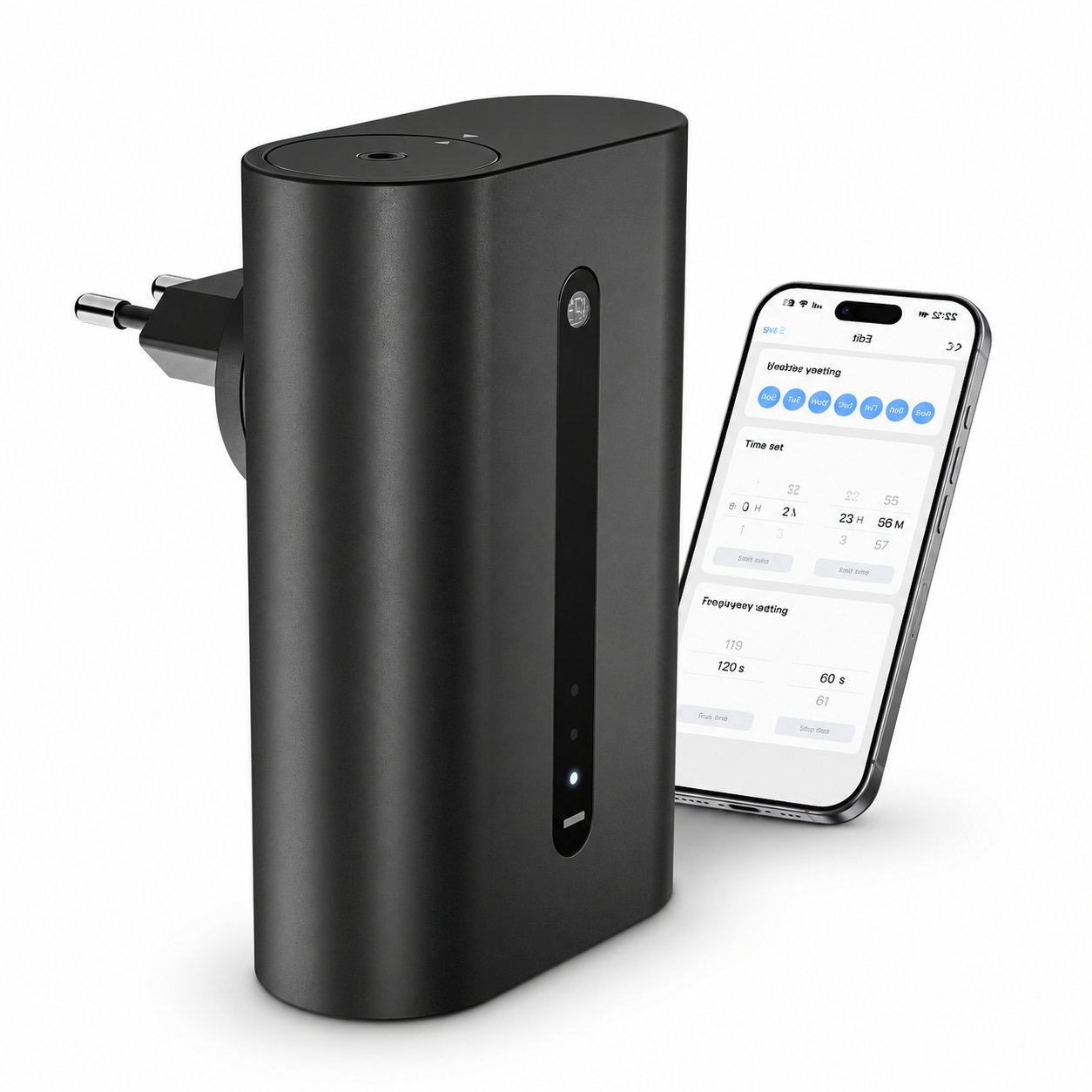
With an app-controlled diffuser, you can preset these moments in advance. For example, program a low setting early in the morning, a slightly more active diffusion around the time guests or customers arrive, and a gentle taper-off later in the evening. This conserves fragrance pods and prevents a space from being continuously perfumed at full strength.
For a home office, a lower, constant setting usually works better than short periods of high output. In retail or hospitality, a slightly stronger setting around opening hours may actually be desirable. First impressions happen quickly: a pleasant scent conveys a sense of care, cleanliness, and quality even before someone has consciously taken in the interior.
Recognize the signs of a setting that’s too high or too low
Scent is personal, but a few signs are virtually universal. Is the scent only noticeable near the diffuser, while the rest of the space remains neutral? If so, the intensity may need to be increased slightly, or the placement needs to be reconsidered. Do you stop noticing the scent quickly, but do visitors still pick it up? If so, the setting is often just right—you’ve simply gotten used to the scent.
This phenomenon is called olfactory habituation. Your nose filters out scents that are constantly present to make room for new stimuli. So don’t automatically increase the intensity just because you can’t smell it as much yourself. Instead, ask a visitor for an honest opinion, or test the space after you’ve been outside for a while.
You can recognize an overly strong scent by a heavy, sweet, or stifling effect. In that case, the scent doesn’t remain elegantly in the background but instead lays a layer over the room. If this happens, lower the intensity and wait a day. Especially with rich, woody, spicy, or amber-like compositions, less is often more. Their character needs time and space.
The fragrance itself determines the ideal setting—
not every fragrance diffuses in the same way. Citrus, green notes, and fresh florals generally feel lighter and may need a bit more support in a larger space. Warm woody notes, vanilla, leather, musk, and spices often have a fuller profile. A lower setting is usually sufficient for these, especially in smaller rooms.
Seasons also play a role. In the summer, windows are more often open and there’s greater airflow. A slight increase in intensity may make sense then. In the winter, rooms tend to stay more closed off, and fabrics and heating contribute to a richer scent experience. In that case, the same setting might suddenly feel too strong.
, When you switch to , a new scent pod , , treat it as a fresh start. On the first day, use a conservative setting, even if your previous scent worked well at a higher setting. This way, you’ll get to know the character of the new scent without the room becoming too intense.
Practical settings that feel luxurious
A carefully configured diffuser requires surprisingly little maintenance. Check every few weeks to make sure it’s still positioned correctly, especially if you move furniture or use a room differently. Keep the device free of dust and check the remaining contents of the fragrance pod. A nearly empty pod may result in a less consistent fragrance experience.
For households with children, pets, or visitors sensitive to scents, a low, steady setting is the most welcoming choice. The same applies in a business setting: a high-quality scent should enhance the environment, not draw attention to the fact that a diffuser is present.
FUSIFY LX is designed precisely for that controlled experience: from a discreet scent in your bedroom to a welcoming ambiance in a larger commercial space. By considering range, scent type, and daily routine together, each setting can achieve its own unique atmosphere without becoming complicated.
The most beautiful scent doesn't stand out because it's overpowering. It lingers because your space feels better the moment you walk in—calmer, warmer, and naturally well-cared-for.